
Wooden Ski and Snowboard Cores
The wood core acts primarily as a separator for the various laminates in the layup such as fiberglass and carbon fiber. It also lends some characteristics to the finished build such as stiffness and overall feeling of the ski or snowboard. Different species vary in stiffness, strength, and weight, and by combining them, builders can fine-tune how skis flex, carve, and hold up over time. Various combinations of wood are laminated together and the entire wood core is surrounded to prevent it from getting wet – above and below by the composites, base and topsheet, and on the sides by a sidewall. Here’s what a finished core looks like:
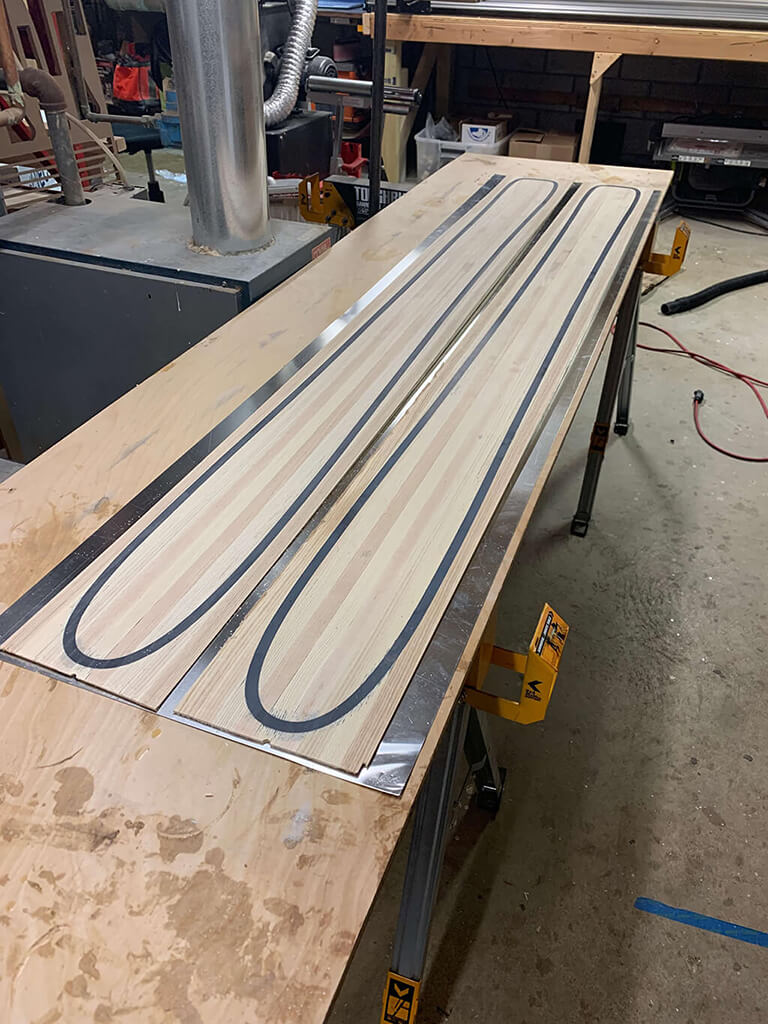
This page covers some wood combinations used in ski building, along with key things to consider when pairing woods.
Common Wood Combinations
Wood combinations vary significantly by region and preference. this is not an all-inclusive list by any means. I recommend building with a couple strips of harder wood to add character while surrounding the with something lighter to manage overall weight of the skis or snowboard.
Ash + Poplar
- Why: Ash adds strength, dampening, and rebound, while poplar keeps the ski lighter and more playful.
- Best for: All-mountain and freeride skis where toughness and edge hold are critical.
Maple + Aspen or Poplar
- Why: Maple provides stiffness and rebound, while aspen (or poplar) softens the flex and reduces weight.
- Best for: Park and freestyle skis that need durability but still remain forgiving.
Birch + Poplar
- Why: Birch creates strong, consistent stiffness, while poplar lowers the swing weight.
- Best for: Carving skis or frontside skis that prioritize reliable edge hold with quick turn response.
Spruce + Ash
- Why: Spruce is lightweight and resilient, while ash reinforces the binding zone and adds rigidity.
- Best for: Touring skis or lighter builds that still need durability underfoot.
All-Aspen or All-Poplar
- Why: Very lightweight, easy to machine, and affordable.
- Best for: Ultralight touring skis, or builds where stiffness comes more from composites than wood.
Wood Combination Comparison Chart and Properties
This table is intended to give you an idea of relative feel for different combinations. My personal favorites are Ash or Maple with Poplar. It’s worth noting that stiffness is tuned primarily with composites and core thickness, not material.
| Combination | Stiffness | Weight | Best Use |
|---|---|---|---|
| Ash + Poplar | High | Medium | All-mountain, freeride |
| Maple + Aspen | High | Medium | All-mountain, freestyle, park, carving |
| Maple + Poplar | High | Medium | All-mountain, freestyle, park, carving |
| Birch + Poplar | Medium | Medium | All-mountain, freestyle, park, carving |
| Spruce + Ash | Medium | Low | Touring, lightweight builds |
| All-Aspen | Low | Low | Lightweight builds |
| All-Poplar | Low-Med | Low | Lightweight builds |
Here are the mechanical properties of some common choices:
| Wood Species | Modulus of Elasticity (kg/mm²) | Modulus of Rupture (kg/mm²) | Density (g/cm³) | Notes |
|---|---|---|---|---|
| Ash (white, green, black, blue) | ~980–1250 | ~9–11 | 0.53–0.64 | Very strong, good rebound, heavier. Excellent for durability. |
| Maple (hard/sugar) | 1290 | 10.97 | 0.676 | Extremely stiff, dense, adds weight but also durability and edge hold. |
| Maple (red/soft, silver, black) | ~805–1155 | ~6–9 | 0.50–0.62 | Softer than sugar maple, can reduce weight. |
| Birch (paper, gray, sweet, yellow) | ~800–1520 | ~7–12 | 0.55–0.71 | Good stiffness, higher density, commonly used in plywood cores. |
| Aspen | 838 | 6.04 | 0.401 | Lightweight, flexible, often combined with stronger woods. |
| Poplar | 716–1058 | 4.7–6.5 | 0.33–0.43 | Very light, easy to work with, reduces swing weight. |
| Spruce (white, black, red) | 1000–1070 | 6–7 | 0.41–0.43 | Light, springy, traditional ski core material. |
Things to Consider When Pairing Woods
- Weight vs. Durability
Heavier woods (maple, ash) increase stability and binding retention but add swing weight. Lighter woods (aspen, poplar, spruce) reduce weight but may not withstand abuse as well. - Binding Zone Strength
Even in lightweight cores, reinforce the binding area with a strip of denser wood (ash, maple, or birch) to prevent pull-outs. - Availability
Many different species can perform the task well. Using locally and responsibly sourced wood can reduce cost and carbon footprint of your skis.
Next Steps
Once you’ve selected your core recipe, the next steps in the build process bring that material to life, Core Lamination, Sidewalls, Core Profiling and binding Inserts. Click on each step in the sidebar to learn how to complete your cores!